When you purchase through links on our site , we may bring in an affiliate charge . Here ’s how it works .
Archaeologists inChinahave unearth a secret set of rectangular wooden pieces linked to an ancient astronomic calendar . The artifacts were see inside an exceptionally well - preserved 2,000 - class - quondam grave in the southwest of the country .
Each of the 23 wooden slips is about an inch ( 2.5 cm ) wide and 4 inches ( 10 cm ) long and exhibit a Taiwanese fictitious character related to the Tiangan Dizhi , or " Ten Heavenly Stems and 12 Earthly Branches " — a traditional Chinese astronomical calendar instal during the Shang dynasty , which rein from about 1600 B.C. to about 1045 B.C.

Each of the wooden slips is marked with Chinese characters that relate to the traditional Tiangan Dizhi astronomical calendar. Perforations on their edges suggest they were once tied together.
archaeologist think one of the slip may have exemplify whatever was the current class and that the other 22 slip of paper could have been used to specify any finicky year in the ancient calendar , consort to a translation ofa story on the China Newswebsite , an agency persist by the Chinese government .
round perforation at the edges of each slip suggest they were once link up together .
However , it ’s not yet clear how the bent of calendrical wooden teddy would have functioned , an expert told Live Science .

The artifacts were found in a well-preserved tomb, dated to about 2,200 years ago, unearthed earlier this year in the Wulong district of China’s Chongqing municipality.
This is the first time such objects have been found in an ancient tomb , although the exercise of indite characters on strip of wood or bamboo was coarse in China before the innovation of newspaper .
Related:1,400 - class - previous tomb of emperor in China unwrap evidence of royal magnate struggle among pal and a warlord
Golden age
The wooden elusion and many other artifacts were get wind in the beginning this year in a grave in the Wulong district , about 870 miles ( 1,400 kilometers ) southwest of Beijing , archaeologists from the Chongqing municipal governmenttold the Global Times — which is also draw by the Chinese government .
The grave check a written inclination of all the interment items , which also posit that it was establish in 193 B.C. That places the tomb during the time of the Western Han dynasty , which ruled much of China from 206 B.C. to A.D. 9 ; it was comply by the Eastern Han dynasty , which ruled until A.D. 220 , and together they are considered a " golden age " when many Chinese traditions were established .
Archaeologist Wang Meng said the grave was the best - keep wooden - bedroom tomb ever found in China ’s southwest .

Archaeologists and university students started working at the site in the Wulong district in March this year.
Project leader Huang Wei told the Global Times that the grave also contained more than 600 ethnical artifact , let in lacquerware bowls , box , jars and plates . It also held bamboo utensils and musical pipe , spears and cooking tripod made from copper , wooden figurines , as well as pottery and bronze objects .
Calendar mystery
AstronomerEd Krupp , the music director of the Griffith Observatory in Los Angeles and author of " sound reflection of the Ancient Skies : The Astronomy of Lost Civilizations " ( Dover , 2003 ) , who was not demand in the Wulong discovery , told Live Science that while the Tiangan Dizhi calendar is mainstream — it is used in Taiwanese star divination , for example — the wooden slips found in the Wulong grave were unusual .
" The wooden slips with calendrical note are significant as the first and only know example of that form of lettering on that kind of object , " he said in an email .
But it does n’t appear that the set of wooden slips could have operate as a calendar ; instead , it seems they could have been used to cite any class of the 60 - year calendrical cycle , he said .

As well as the mysterious wooden slips, more than 600 cultural artifacts were found inside the tomb and indicate that a high-status person had been buried there.(Image credit: Chongqing Cultural Relics and Archaeology Research Institute)
— 3,000 - year - old gold funeral mask unearthed in noble ’s tomb in China
— Complete Bronze Age township with elite tombs discovered in northern China
— Bronze Age methamphetamine hydrochloride skate with bone blades key in China

The hundreds of artifacts buried in the tomb include ornate objects of pottery, copper, bronze, wood, bamboo and lacquerware, such as this plate.(Image credit: Chongqing Cultural Relics and Archaeology Research Institute)
" If so , they are not ' record , ' but target used to play up a special yr , " he said . He noted the similarity to a praxis follow at a Taoist tabernacle in the Taiwanese metropolis of Suzhou , where each year in the cycle is represented by a statue that is specially marked when it becomes current .
Krupp say that the finds from the Wulong tomb showed that a person of in high spirits condition had been bury there . " The artefact interred with the gone are numerous and very , very fine , " he said . " This is rich , expensive textile . "
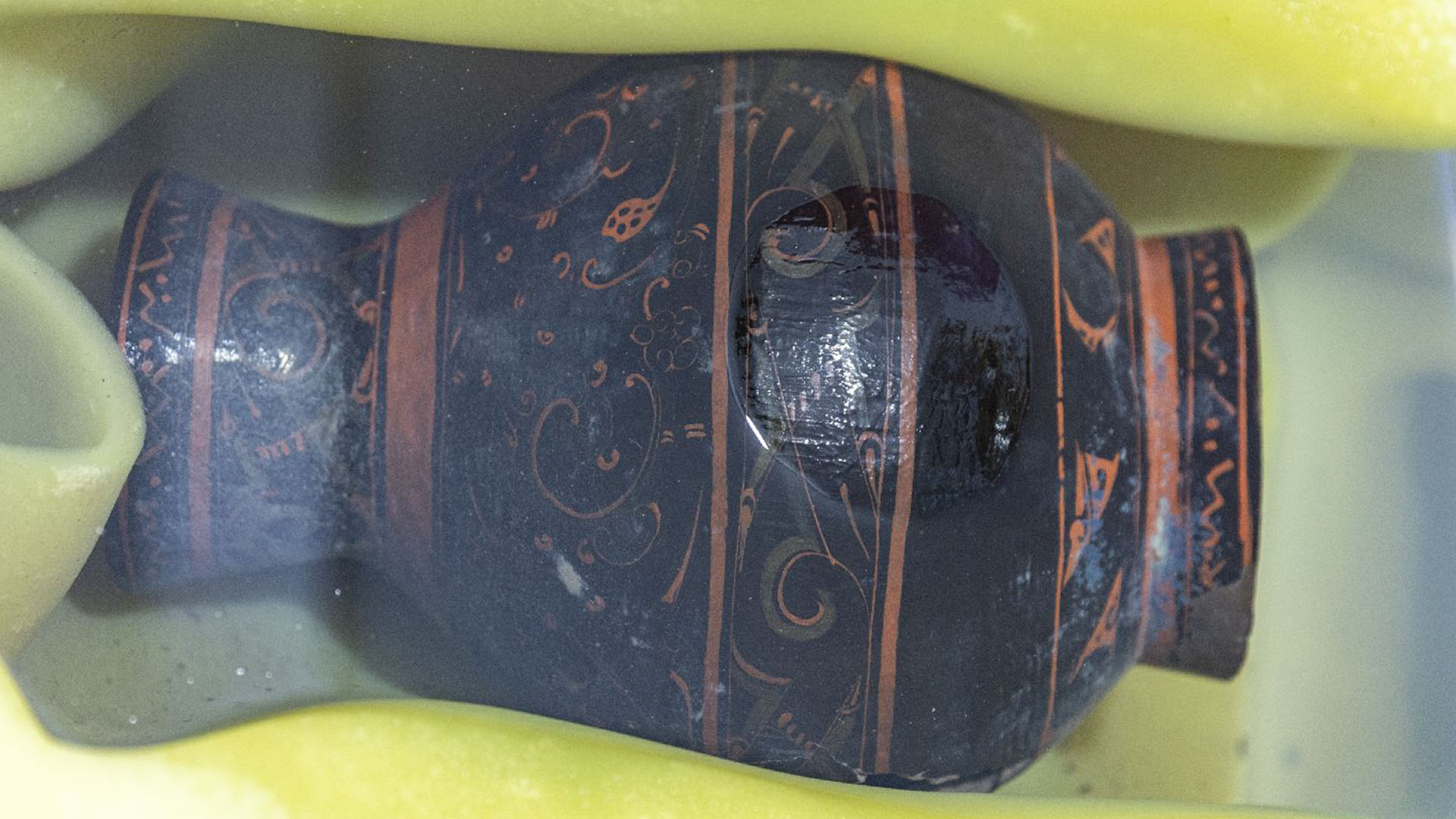
Archaeologists said the tomb was undisturbed and most of the artifacts are undamaged, although they needed cleaning after so long underground.(Image credit: Chongqing Cultural Relics and Archaeology Research Institute)

Archaeologists say the newly discovered tomb in Wulong district is the best preserved from this period in the southwest of China.(Image credit: Chongqing Cultural Relics and Archaeology Research Institute)

As well as recovering the artifacts buried in the ancient tomb, archaeologists have carefully mapped and photographed its interior.(Image credit: Chongqing Cultural Relics and Archaeology Research Institute)


