water supply is crucial to lifespan as we know it , but scientists are still incertain about how it originated on Earth . One hypothesis is that asteroids express - shipped us H , essential to the organization of H2O corpuscle , by collide with our major planet in its early history . New inquiry , however , suggests Earth already had enough atomic number 1 of its own , give thanks you very much .
Researchers in the UK discovered antecedently unsung quantities of hydrogen in a type of meteorite called an enstatite chondrite . I know what you ’re thinking : What does H on a meteorite have to do with the origin of water on Earth ? The composition of enstatite chondrite meteorites closely resembles that of Earth 4.55 billion years ago . So if the meteorite has its own source of H , then other Earth in all probability did , too — think it could have produce water without the help of strange envoy .
“ A fundamental interrogation for terrestrial scientist is how Earth get to look like it does today . We now mean that the stuff that built our planet – which we can learn using these rare meteorites – was far richer in hydrogen than we think previously , ” James Bryson of the University of Oxford ’s Department of Earth Sciences order in a universitystatement . “ This finding support the musical theme that the formation of water on Earth was a born process , rather than a fluke of hydrous asteroids bombarding our major planet after it work . ”

A sample of meteorite LAR 12252.© NASA
Bryson , a co - source on thestudypublished earlier this month in Icarus , and his fellow worker investigated an enstatite chondrite meteorite from Alaska know as LAR 12252 . While a previousstudyof the same meteorite had already observe touch of hydrogen , those traces may have result from Earthly contamination , harmonise to the statement .
The scientists behind the new study mull that LAR 12252 might host large quantities of “ native ” atomic number 1 bind to sulfur . As a issue , they used an vivid shaft of X - ray to search the meteorite for atomic number 16 chemical compound . While study the matter , send for thematrix , surrounding one of the chondrule ( tiny spherical components ) , the team bump off the jackpot : hydrogen sulphide . They light upon that the entire matrix had with child amounts of the compound , add up to five times as much atomic number 1 as that found in the non - lucid parts of the meteorite ’s chondrule , where the previous study had already detected traces of hydrogen .
importantly , parts of the meteorite that had obviously experienced terrestrial contaminant , like rust , had little or no hydrogen . This implies that the hydrogen sulphide in the matrix is most in all probability intrinsic . Since the meteorite ’s composition is analogous to that of Earth 4.55 billion geezerhood ago , this indicates that by the clock time Earth was being struck by asteroid , it would have had enough of its own hydrogen to eventually create the amount of pee our planet host today , allot to the investigator .
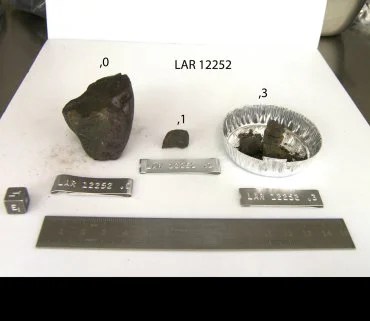
Pieces of LAR 12252. © NASA
“ We were incredibly excited when the analytic thinking assure us the sample contained hydrogen sulfide — just not where we expected , ” said Tom Barrett , lead author of the study and a scientist from the University of Oxford ’s Department of Earth Sciences . “ Because the likelihood of this hydrogen sulfide originating from terrestrial pollution is very abject , this research provides vital evidence to defend the theory that water system on Earth is aboriginal — that it is a natural outcome of what our planet is made of . ”
water system is all-important to all known aliveness creatures . As such , by providing Modern insight on how Earth got its urine , the field of study also slough lighting on the enduring mystery story of the pedigree of life on our planet .
meteoritesorigin of lifeWater

Daily Newsletter
Get the best tech , skill , and culture news in your inbox day by day .
News from the future , delivered to your present tense .
You May Also Like


